If you’ve ever stood behind a commercial fried snacks processing machine during a production run, you know that the hum of the fryer isn’t just background noise—it’s the sound of consistency. Too often, I hear from my clients—small batch snack makers, medium-sized food processors, even artisanal brands that’ve scaled up from a home kitchen—that they struggle with one make-or-break detail: oil temperature. A fry that’s 20 degrees too hot leaves a burnt, undercooked crumb; 20 degrees too cool leaves a soggy, oily snack that turns off customers and creates waste. As a fried snacks processing machine supplier, I don’t just sell equipment—I help my clients nail this balance because I’ve seen firsthand how temperature control makes or breaks their bottom line. Fried Snacks Processing Machine
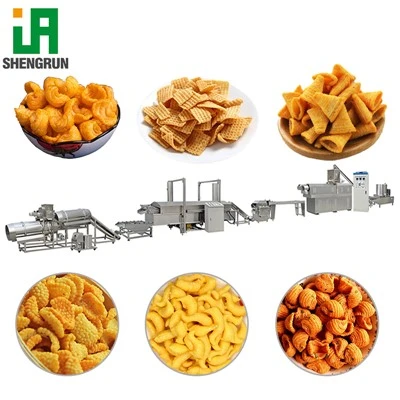
Let’s start with why this isn’t just a “set it and forget it” task. When you fry a snack—think potato chips, corn tortillas, or veggie straws—oil doesn’t just cook the food. It does three key jobs: it kills harmful bacteria on the snack’s surface, it triggers the Maillard reaction that gives snacks that golden, crispy flavor and color, and it removes excess moisture to keep the snack light, not greasy. If oil temperature fluctuates even a little, all three jobs go off track. Too low, and bacteria might not be fully eradicated, leading to safety risks, and moisture gets trapped, turning the snack soggy. Too high, and the outside burns before the inside cooks through, creating a bitter taste and wasting oil (overheated oil breaks down faster, leaving you replacing it every few runs instead of every few weeks).
After nearly a decade of working with different processors, I’ve found that the biggest mistake new operators make is trusting old-school methods: guessing temperature, relying on analog thermometers that are off by 10-15 degrees, or adjusting the heat based on how recently they filtered the oil. That’s why every machine I ship comes with built-in temperature monitoring, but even seasoned operators can slack on the small, daily steps that keep oil temperature stable. Let’s break down the actionable steps we share with every client, the science behind them, and the common missteps that trip people up.
First, get your machine’s heating and circulation systems right—this isn’t just hardware, it’s the foundation of temperature control. A lot of budget fried snacks processing machines cut corners here: their heating elements are spaced too far apart, so one end of the fry zone is 100 degrees hotter than the other, or their circulation pumps are too weak, so oil hangs in stagnant pockets where it cools unevenly. I once had a client in Georgia who was running potato chips on a used machine they’d bought secondhand. They’d test temperature at one end of the fryer, but the chips coming out the other end were consistently oily because oil wasn’t moving. We swapped out their underpowered circulation pump for a variable-speed model that adjusted to the fry zone’s heat, and within three runs, their oil waste dropped by 22%—that’s thousands of dollars a year they saved, plus a more consistent product.
Here’s the science: oil has a thermal conductivity rate, meaning it transfers heat at a specific speed. When circulation is poor, the oil near the heating element heats up too fast, but the oil surrounding the snack cools because it’s not being replenished. A variable-speed pump matches the flow of oil to the number of snacks being fried—if you’re running a light batch of veggie straws, the pump slows to keep oil from splashing, but when you run a full load of thick potato chips, it speeds up to keep every chip submerged in oil at the correct temperature. I always tell clients: your fryer isn’t a hot tub—you don’t want areas that are “hot spots” or “cold spots” scattered throughout.
Next, calibrate your temperature sensors daily, not when you first set up the machine. I can’t stress this enough. Analog thermometers drift over time, even digital sensors on mid-range machines can shift by 5-8 degrees if they’re exposed to splashing salt, crumbs, or fried debris. I’ve seen a client in Texas where their digital sensor read 350°F (175°C) but the actual oil temp was 335°F (168°C)—they were under-frying chips for weeks, leading to a 12% return rate from customers who complained about sogginess. The fix took 10 minutes: we had them test the sensor in boiling water (which is a consistent 212°F, or 100°C, at sea level) and adjust the calibration setting on their machine’s control panel to match. For every 500 feet of elevation, subtract 1.8°F from boiling water, so if you’re in Denver, test at 207.2°F and calibrate accordingly. This small step eliminates a huge amount of avoidable inconsistency.
Another key point: preheat the oil correctly, not just to the target temp. A lot of operators turn on the machine, walk away, and come back when the screen says it’s at 350°F. But when you first turn on a fryer, the heating elements take time to stabilize, and if you load snacks too soon, they’ll cool the oil rapidly. I recommend preheating your oil to 25-30 degrees below your target temp, then holding it there for 15 minutes, then cranking the heat to your target. This lets the entire volume of oil reach a uniform temp, not just the layer near the heating element. For example, if you fry potato chips at 350°F, preheat to 320°F, hold, then adjust to 350—when you load the first batch, the oil will only drop 5-10 degrees instead of 20, which is the sweet spot for a crisp, evenly cooked chip.
Then there’s batch management—how you load snacks into the fry zone directly impacts oil temperature. This is a step that’s easy to overlook, but it’s where a lot of even well-equipped machines go off track. If you overload the fry zone, the oil can’t circulate around every snack, leading to cold spots. I always advise clients to load the fry zone to 75% capacity, max. That means if your machine holds 50 pounds of snacks, you load 37.5 pounds—not more. Why? Because when you submerge a batch of cold snacks, they absorb a small amount of oil, which temporarily cools the surrounding oil. If you cram too many in, that cooling effect is magnified. Also, don’t drop snacks all at once—load them in batches every 10-15 seconds, so the oil has time to recover its temperature between loads. I had a client in Florida who was loading all their pretzels at once, and their oil temp dropped from 350 to 315, leading to greasy pretzels. After adjusting their loading schedule, their oil turnover (how often they had to replace it) went from every 5 days to every 9 days.
Wait, what about oil quality? You might be wondering, “Does oil freshness tie into temperature control?” The short answer is yes, but it’s not about “good” vs “bad” oil—it’s about how old oil behaves at different temps. Over time, oil breaks down from use, absorbing moisture and debris, and its smoke point drops. The smoke point is the temperature where oil starts to smoke, break down, and create bitter flavors, plus it releases harmful compounds. If you fry at or above the smoke point of old oil, you’ll get inconsistent temperature because the oil is breaking apart, so it doesn’t transfer heat evenly. That’s why we advise clients to filter their oil after every 2-3 production runs, and test its smoke point monthly. A simple test: heat a small cup of oil to 375°F—if it smokes, it’s time to replace it, no exceptions. If you use our machines, we even include a built-in oil filtration system that lets you filter oil without stopping production, which cuts down on downtime and keeps oil temp stable because you don’t have to drain and refill the fryer mid-batch.
Now, let’s talk about common myths I hear all the time. One is: “Higher temperature makes crispier snacks.” That’s only true up to a point. The Maillard reaction (the reaction that creates flavor and color) works best at a consistent temp between 325-375°F, depending on the snack. Go over 375, and you’ll burn the surface before the inside cooks, and the oil will break down faster. Another myth: “Digital controls mean you don’t have to check the temp.” Even the best digital controls can have glitches—we recommend checking the oil temp with a calibrated, waterproof thermometer at least twice per shift, to make sure the machine’s readings are accurate. Last year, a client in Ohio had a faulty temperature sensor on their machine that read 350, but actual temp was 380, leading to burnt chips and $1,200 in wasted oil before we caught it. Checking in person eliminates that risk.
What about for smaller operations? If you’re running a small-batch fried snacks business, you might not have a big industrial machine, and that’s okay—these steps still apply. Even a countertop commercial fryer can have consistent temperature if you calibrate the sensor, circulate the oil (you can do this manually by stirring gently, though a small pump is better), and don’t overload the basket. I work with a lot of craft snack makers who started with small machines and grew to medium sizes, and the core rules never change: consistent temp comes from consistent equipment, consistent checks, and consistent habits.
Here’s the big picture: when you control oil temperature properly, you’re not just making better snacks—you’re saving money, reducing waste, and building customer loyalty. A snack that’s crispy on the outside, light on the inside, and consistent every time will have customers coming back, and your team will spend less time troubleshooting sogginess or burnt batches and more time focusing on growth.

If you’re struggling with oil temperature control in your fried snacks processing machine, or you’re looking to upgrade your equipment to make temperature consistency easier, we’re here to help. We offer custom solutions tailored to your production volume, from small-batch machines to industrial fry lines, and our team provides hands-on training to make sure you’re using every feature to its full potential. We also offer ongoing support for calibration, maintenance, and troubleshooting, so you never have to worry about mid-batch surprises. Let’s connect to talk through your specific needs, whether you’re a startup just launching your first line or an established brand looking to scale.
Fish Feed Production Line References
- Farkas, D. F. (2017). Thermal Processing of Foods: Principles and Applications. CRC Press.
- Smith, J. S. (2020). Oil Quality and Temperature Control in Fried Food Processing. Journal of Food Engineering, 289, 110782.
- United States Food and Drug Administration. (2021). Good Manufacturing Practices for Fried Snack Foods. FDA Center for Food Safety and Applied Nutrition.
- Patel, R. K., & Mehta, B. M. (2019). Heat Transfer and Circulation in Deep Fat Fryers: A Review. Food and Bioprocess Technology, 12(8), 1297-1312.
Jinan Shengrun Machinery Co., Ltd.
We are one of the most professional fried snacks processing machine manufacturers and suppliers in China, featured by quality products and good price. Please rest assured to buy durable fried snacks processing machine for sale here from our factory. Contact us for more details.
Address: 1817 Rongce Center, No.3179 Qilu Avenue, Xingfu Street, Huaiyin District, Jinan City, Shandong Province
E-mail: sales@foodgm.cn
WebSite: https://www.food-gm.com/
