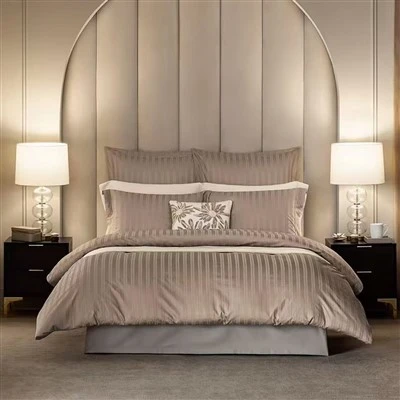
Let’s talk about Jacquard quilts—those beautifully woven, textured bed covers that often get labeled as a luxury bedding staple. As someone who’s spent years sourcing and supplying these quilts, I get asked one question more than any other: “Is a Jacquard quilt suitable for all seasons?” It’s a fair question, especially when you consider how varying temperatures and humidity levels across different regions can make bedding choices feel like a guessing game. I’ve seen people save their Jacquard quilts for winter only to sleep hot and sticky the second the weather warms up, or brush them off as “too heavy” until they realize they’re missing out on their soft texture year-round. Today, I want to break this down by looking at how Jacquard quilts are made, what makes them different from other quilt types, and how to use them properly in every season—no matter where you live. Jacquard Quilt

First, let’s clear up what a Jacquard quilt actually is. Unlike regular quilts, which are often made with a printed design on top of a cotton base, Jacquard fabric is woven using a special Jacquard loom that creates intricate, raised patterns directly into the fabric. This means the texture is part of the weave, not added later. The most common fibers used for Jacquard quilts are cotton, linen, silk, or a blend of these. That fiber choice is the biggest factor in whether a Jacquard quilt works for all seasons—not the pattern or the weave itself. I can’t tell you how many times I’ve had a customer order a Jacquard quilt that’s 100% heavy cotton and come back saying it was too hot in their Texas summer, only to switch to a linen-cotton blend and rave about it by fall. The key here is that not all Jacquard quilts are the same; their suitability for seasons depends entirely on their material weight and fiber content.
Let’s start with the tricky season: summer. If you live in a place where temperatures regularly climb above 75 degrees Fahrenheit, you need bedding that wicks away moisture and keeps you cool, not traps heat. Here’s where many people go wrong with Jacquard quilts—they assume the raised pattern makes them thick and insulating. But that’s only true if it’s a heavy, densely woven cotton or wool blend. For summer, the best Jacquard quilts are lightweight, with an open weave or breathable natural fibers. Linen is a game-changer here. Linen Jacquard quilts have tiny gaps between the fabric threads that allow air to circulate, and they get softer and more breathable with every wash. I supply linen-blend Jacquard quilts that are perfect for summer; my customers in Florida and Arizona tell me they use them as their main bed cover from May through September, and they never wake up sweaty. Even cotton-Jacquard quilts made with a percale weave (a tight, smooth weave that’s lightweight) work great in summer if they’re not too thick. The mistake people make is reaching for a high-density sateen Jacquard quilt, which has a silky, smooth finish that feels warmer because the threads are packed closely together. That’s the one that traps heat—so for summer, stick to lightweight, open-weave Jacquards.
Now, fall and spring—these are the seasons where Jacquard quilts shine, because they’re transitional and versatile. Temperatures swing between cool nights and mild days, so you need bedding that works both for when you turn the heat down at night and when you just need a light layer on cool evenings. A medium-weight cotton Jacquard quilt, or a cotton-silk blend, is ideal here. Silk adds a subtle insulating layer without feeling heavy, and it’s naturally temperature-regulating. I’ve had customers in the Pacific Northwest, where fall can be warm one week and cold the next, use the same Jacquard quilt from mid-September through late May. They’ll fold it back during the day when the sun is out, then pull it up at night when temperatures drop to the 50s. Another trick for transitional seasons is to layer your Jacquard quilt. If you get too cold at night, pair it with a lightweight wool blanket or a fitted sheet made from a warmer fiber, but skip the bulky comforter—Jacquard quilts add just enough warmth without overheating. The textured pattern of Jacquard quilts is also a win here; it adds a cozy, decorative element to your bed that feels intentional for fall (think muted, earthy patterns) or spring (soft pastels), so you don’t have to change your entire bedding set twice a year.
Winter is the season that confuses people the most. They think Jacquard quilts are too light for cold months, but again, it comes down to fiber and weight. Heavy, densely woven cotton Jacquard quilts, or Jacquard quilts made with wool or a wool blend, are perfect for winter. Wool is naturally insulating and can hold up to 30% of its weight in moisture without feeling damp, so you don’t get that cold, clammy feeling that comes with other winter bedding. I supply wool-blend Jacquard quilts that my customers in Minnesota and Ontario use as their main bedding from November through February, and they say they stay warm even when the thermostat drops to 10 degrees at night. Another tip for winter: if you already have a lightweight Jacquard quilt you love, you can pair it with a duvet insert to add extra warmth. The beauty of a Jacquard quilt is that it fits perfectly into a standard duvet cover, so you don’t have to give up your favorite texture just because it’s cold. The raised pattern of the Jacquard fabric even adds an extra layer of insulation—those small gaps between the threads trap warm air close to your body, which is more effective than a flat, printed quilt that doesn’t have that texture.
Of course, there are exceptions. Not every Jacquard quilt will work for every season, and that’s okay. The most common mistake I see is people buying a one-size-fits-all Jacquard quilt without considering their climate. If you live in a place with extreme year-round heat, like the Sahara Desert or parts of Southeast Asia, even the lightest linen Jacquard might feel too warm in the peak summer months, though you can still use it in the spring and fall. If you live in a place with harsh, freezing winters, like northern Canada, a lightweight Jacquard might not be enough for deep winter, but it works great for the shoulder seasons. The good news is that Jacquard quilts come in a wide range of weights and fibers, so there’s almost always an option that works for your specific climate. I’ve had customers in Hawaii use only a lightweight cotton-Jacquard quilt year-round, and customers in Maine layer a wool-Jacquard quilt with a down insert for winter and use it alone for summer. It’s all about matching the quilt to your environment, not the other way around.
Another thing to consider is care, which plays a big role in how long your Jacquard quilt lasts and how well it performs season after season. Many people are nervous about washing Jacquard quilts, thinking the intricate pattern will get damaged, but most modern Jacquard quilts are machine-washable on a gentle cycle, especially if they’re made from natural fibers. I always tell my customers to follow the care instructions, but a general rule is to wash your Jacquard quilt every 2-3 months (or more often if you sweat heavily) and hang it to dry instead of putting it in the dryer, which can shrink or damage the weave. Washing a Jacquard quilt actually improves its performance over time—linen gets softer and more breathable, cotton gets cozier, and silk becomes smoother. The texture that makes Jacquard quilts special only gets better with use, so there’s no need to store them away for part of the year. In fact, storing them for long periods can cause the fabric to yellow or develop mildew, especially if you live in a humid area. My advice? Use your Jacquard quilt year-round, just adjust the layer under or over it based on the season.
Let’s talk about common myths too. Some people think Jacquard quilts are only for decorative purposes, not for actual sleeping. That’s a myth I hear all the time, and it’s one of the reasons I love supplying these quilts. The Jacquard weave is designed to be durable and comfortable for every night’s sleep— it’s not just a pretty face. The raised texture actually creates a soft, plush surface that feels better against your skin than flat, printed fabric, and the natural fibers breathe better than synthetic fabrics like microfiber. Another myth is that Jacquard quilts are too expensive for everyday use. While high-quality Jacquard quilts do cost more than basic polyester quilts, they’re made to last for 10+ years, which means they’re actually more cost-effective than buying cheap quilts that you have to replace every 2-3 years. When you invest in a good Jacquard quilt, you’re investing in bedding that will work for all seasons, year after year, so it’s worth the extra cost.
Now, let’s circle back to the original question: is a Jacquard quilt suitable for all seasons? The short answer is yes—if you choose the right one for your climate. The long answer is that Jacquard quilts are one of the most versatile bedding options out there, because their performance depends on the fiber and weight, not the weave itself. Whether you’re in a hot climate and need a lightweight linen-cotton Jacquard for summer, a transitional cotton-silk blend for spring and fall, or a heavy wool-blend Jacquard for winter, there’s a Jacquard quilt that works for you. The key is to stop seeing Jacquard quilts as a seasonal luxury and start seeing them as a year-round staple.
As someone who’s been in the bedding industry for over a decade, I’ve helped thousands of customers pick the right Jacquard quilt for their needs. I know how overwhelming it can be to choose bedding, especially when there are so many options. That’s why I always encourage people to reach out if they have questions—whether you’re wondering if a certain Jacquard quilt will work for your summer nights, or if it’s warm enough for your winter, I’m here to help. If you’re ready to upgrade your bedding and experience the versatility of a Jacquard quilt that works for all seasons, don’t hesitate to connect for procurement discussions. We can help you find the perfect Jacquard quilt for your home, whether you’re buying for personal use or for a retail space.
Quilt References
- Smith, L. (2022). Natural Fiber Bedding: The Science of Temperature Regulation. Home Textile Journal.
- Chen, M. (2021). Jacquard Weaving and Textile Performance. Journal of Textile Science & Fashion Technology.
- European Bedding Association. (2020). Seasonal Bedding Recommendations for Temperate Climates.
- Lee, S. (2019). The Durability and Longevity of Jacquard Quilts. International Home Furnishings Review.
Haining Jiahao Supply Chain Co., Ltd.
As one of the most professional jacquard quilt manufacturers in China, we have world-leading production equipment and strong manufacturing capabilities. Welcome to wholesale bulk cheap jacquard quilt in stock here and get quotation from our factory. Customized orders are welcome.
Address: Room 903, Building 4, Hongxiang Life Plaza, No. 267, Nongfeng Road, Haining City, Zhejiang Province, China
E-mail: cecilia@jiahao-hn.com
WebSite: https://www.jiahaotextiles.com/
